
If youve ever won five games in a row, watched your rank barely budge, then lost one and dropped a full division youre not alone. The Overwatch 2 competitive ranks system can feel like a black box, but once you understand how hidden MMR (Matchmaking Rating) actually works, youll stop blaming losers queue and start climbing smarter. This guide breaks down the difference between your visible rank and your real MMR, how the matchmaker builds teams, and what actually moves the needle on your progression.
Heres the single most important takeaway: your visible skill tier resets every season, but your hidden MMR carries over. That means a Bronze 5 player with a high MMR will skip divisions after placements, while a Diamond player with a low MMR will struggle to climb until their wins prove they belong. Blizzard uses MMR not your profile badge to form every match, so grinding your rank icon without improving your underlying skill wont get you fairer games.
What Is MMR and How Is It Different from Your Visible Rank?
Your MMR is a hidden number that represents your true skill, calculated per role. In Overwatch 2, the matchmaker only looks at MMR when forming teams your outward-facing rank (like Gold 3 or Diamond 1) is purely cosmetic. This is why you sometimes face players with a different badge: their MMR matches yours even if their rank doesnt. Each competitive season lasts about 810 weeks, and while your visible rank resets, your MMR stays mostly intact, allowing the algorithm to evaluate improvement over time instead of short-term streaks.
Your MMR rises when you win games against opponents of similar or higher MMR, and it falls when you lose. Crucially, performance stats like damage or healing dont directly affect MMR only win/loss matters after the first few games on a new account. If you stop playing for a long period, your MMR will gradually decay to its original starting point to account for rust. And because Blizzard wants to prevent manipulation, they never show you your exact MMR value.
- Hidden MMR vs. visible rank: The matchmaker uses only your role-specific MMR to build teams, never the skill tier or division shown on your profile. Your badge is a rough estimate, not the truth.
- Seasonal reset: At the start of each 810 week season, your visible rank resets after placement matches, but your hidden MMR persists. This lets you climb faster if youve genuinely improved.
- MMR decay: After a period of inactivity, your MMR will slowly decay back toward its starting point. Logging in and playing a few matches stops the decay.
- Per-role MMR: You have a separate MMR for each role (Damage, Tank, Support). Climbing as a Support wont help your Tank rank you have to prove yourself in each queue.
How Matchmaking Uses MMR to Build Teams
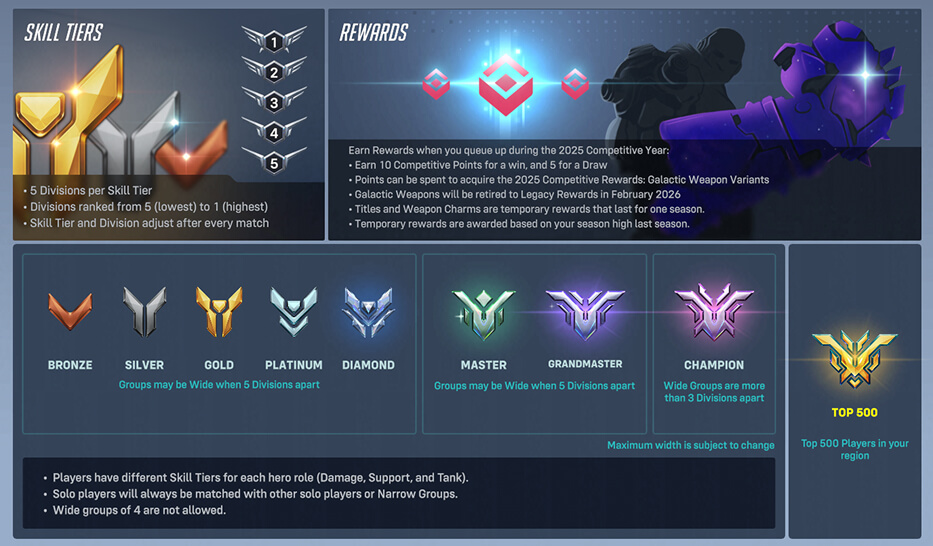
Blizzards matchmaker aims for balanced games, and theyve stated that in most lobbies the win probability split doesnt lean further than about 55/45% in either teams favor. To achieve this, the system compares every players MMR and tries to form two teams with a similar total rating. The targeted wait time the time the system will wait to find two teams of somewhat similar rating is a key parameter; if it cant find a perfect match, it broadens the search slightly rather than forcing an unbalanced game.
There is no such thing as a winners queue or losers queue. Blizzard has confirmed that no such system exists. Your MMR is adjusted only after you win or lose a game, or if you return from a long break. The rank you see in a players profile is not the same as their MMR, so dont panic if a teammate has a different badge the system already matched you based on skill, not cosmetics.
- 55/45% balance target: The matchmaker rarely creates games where one team has more than a 55% chance to win. Most lobbies are close to 50/50 when MMR is properly matched.
- Targeted wait time: The system waits a set duration to find two teams of similar MMR. If no perfect match appears, it gradually expands the search range instead of forcing an unfair game.
- No winners or losers queue: Despite forum rumors, Blizzard has explicitly denied any queue manipulation. Your MMR moves only on win/loss and decay, not on streaks engineered by the system.
- Smurf detection via streaks: New accounts on extended win streaks see their MMR adjust quickly to place them at their true skill level. This prevents smurfs from stomping lower ranks for long.
Climbing the Ranks: What Actually Moves Your MMR
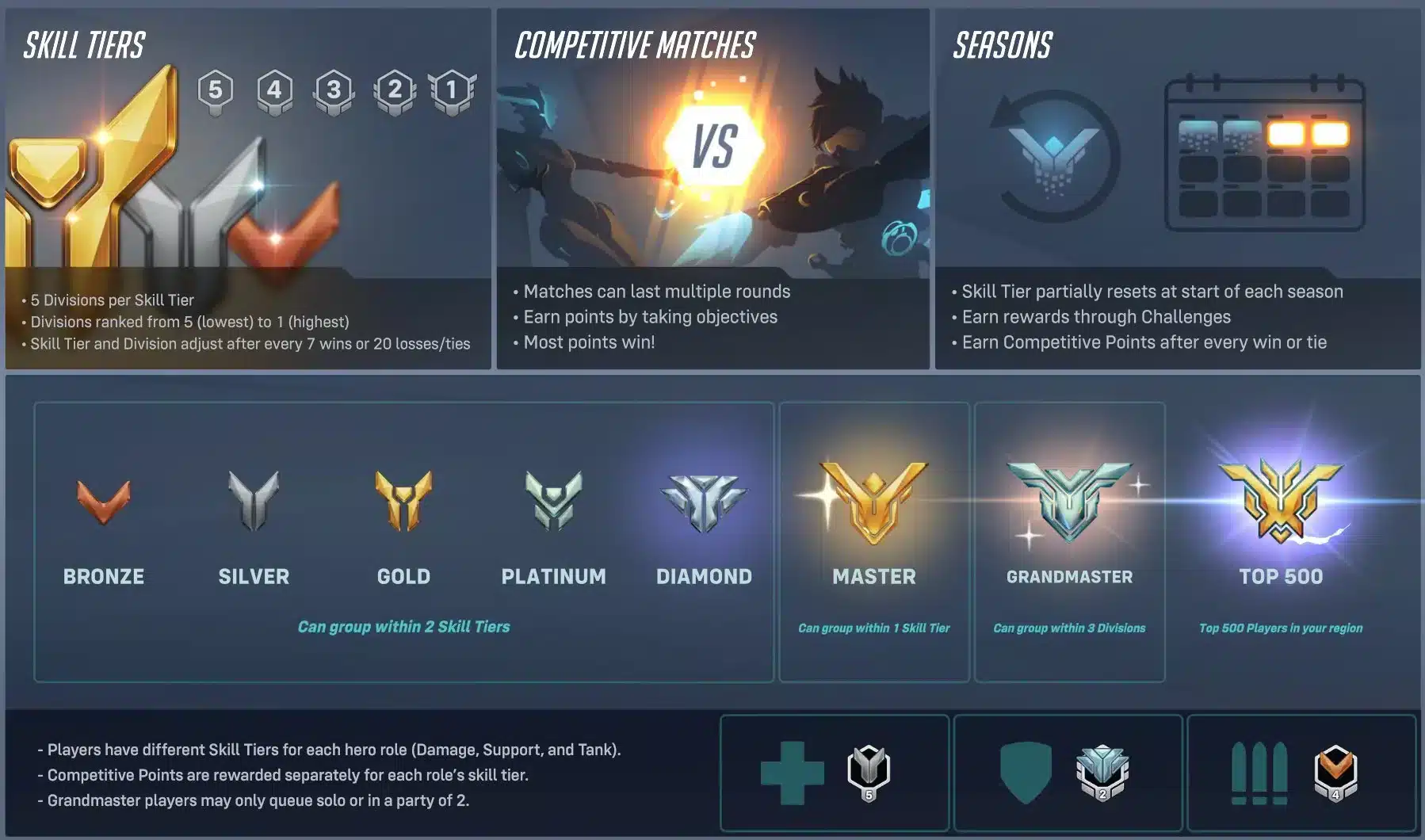
The golden rule: MMR is still mostly based on win/loss. After your first few placement games on a fresh account, individual performance stops influencing MMR adjustments. That means you cant stat pad your way to a higher rank you have to win games. However, consistency matters: if you go on a long win streak, your MMR will adjust faster to pull you toward your true skill, which is why smurfs climb quickly and then plateau. Conversely, a losing streak will drop your MMR more aggressively if the system thinks youre overrated.
Your visible rank follows your MMR with some lag. If you maintain a high win rate over many games, your badge will eventually catch up. The ranked system also features Competitive Drive events (introduced in Season 12) where you earn a Competitive Signature cosmetic based on how many Drive points you collect during the event. These events dont affect MMR directly, but they give you extra rewards for playing during specific windows. And remember: weapon variants cost 3,000 Competitive Points each and at the start of each year, any unspent points convert to Legacy Competitive Points, so spend them before the new variant drops.
- Win/loss is king: After your initial placement games, only match outcomes change your MMR. Consistent winning over dozens of games is the only reliable way to climb.
- Win streaks accelerate MMR: If you win several games in a row, your MMR adjusts faster than normal to place you against tougher opponents. This helps legit players climb quickly and punishes smurfs.
- MMR decay after inactivity: Stop playing for weeks or months and your MMR will slowly drop toward its original starting point. Play at least a few matches per season to maintain your rating.
- Competitive Drive events: Seasonal limited-time events let you earn a special BattleTag signature. The more Drive you earn, the more elaborate the cosmetic but they dont affect your MMR or rank.
Placement Matches: How Your Rank Is Recalibrated Each Season

Every new competitive season requires you to play 5 placement matches per role before your visible rank appears. Your MMR carries over from the previous season it is never fully reset. Instead, those 5 matches serve as a slight recalibration: a strong performance (e.g., 41 or 50) can push your MMR up by roughly 100150 SR equivalent, while a poor showing (14 or 05) may drop it by a similar amount. The first season on a new account uses a separate calibration pool; after your first 50 Quick Play wins, you must play 10 placement matches to get an initial MMR estimate.
After placements, your visible rank is set based on your MMR, but you can continue to climb or fall normally. Note that leaving a placement match counts as a loss and incurs a 15-minute competitive ban (escalating on repeated offenses). If you skip a season entirely, your MMR decays slowly (as described earlier), but your rank will be hidden until you complete the 5 placements the next season.
- 5 placement matches per role: Required each season to receive a visible rank; MMR is adjusted by roughly 100150 SR based on win/loss record.
- No full MMR reset: Your hidden MMR from previous seasons persists; placements only fine-tune it by a few dozen points.
- New account calibration: After 50 Quick Play wins, you play 10 placements to establish a baseline MMR before entering competitive.
- Leaver penalty during placements: A disconnection counts as a loss for that match and triggers a 15-minute ban; repeated leaves escalate to 1-hour and season bans.
Role Queue MMR: Separate Ratings for Tank, Damage, and Support
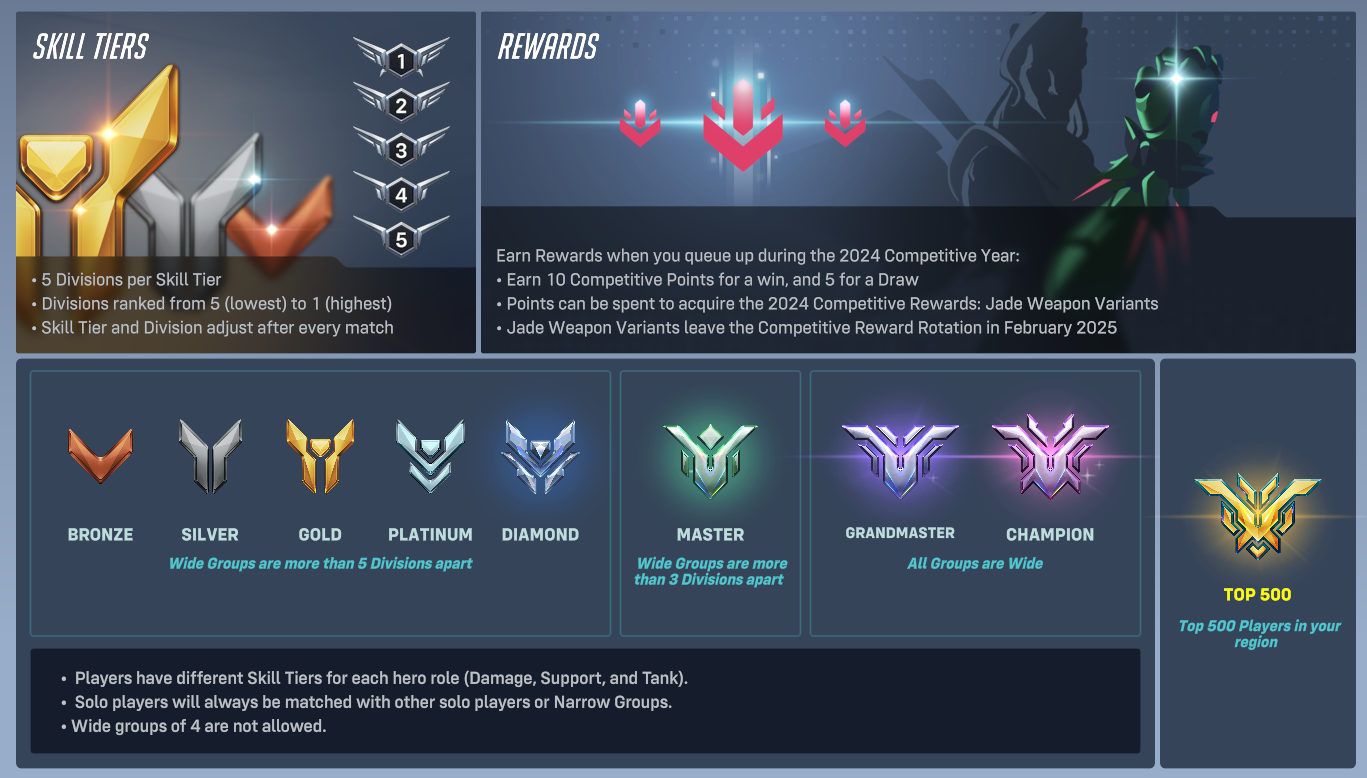
Overwatch 2 maintains three independent MMR values one for Tank, one for Damage, and one for Support. This means you can be a Gold 3 Tank while holding a Platinum 1 Support rank. Matchmaking uses the role-specific MMR when building teams: the system matches your Tank MMR against the enemy Tanks MMR, your Damage MMR against their Damage, and so on. This separation prevents a player who is weak on one role from dragging down the quality of matches on other roles.
When you queue for multiple roles, the matchmaker uses the highest MMR among your selected roles to find a game. For example, if your Support MMR is Diamond but your Tank MMR is Gold, queuing for both roles will match you at the Diamond level for whichever role you receive. This can create uneven games if you get placed into your weaker role. To avoid this, the game offers a Flex queue that prioritizes the role with the longest wait time, but still uses the same MMR logic. Blizzard has stated that role-specific MMR ensures fairer matches than a single combined rating, as each role demands different skills and game sense.
- Three independent MMRs: Tank, Damage, and Support each have their own hidden rating; visible rank per role updates separately after every 5 wins or 15 losses.
- Cross-role matchmaking: When queuing multiple roles, the system uses the highest MMR among selected roles to build the lobby, which can cause imbalance if you are placed into a weaker role.
- Flex queue priority: Choosing Flex gives you faster queue times by filling the most needed role, but still applies the same highest-MMR matchmaking rule.
- Role separation prevents skill bleed: A player who excels at Support but is average at Tank will not inflate or deflate the match quality for other players in the Tank role.
Frequently Asked Questions
Does my MMR reset every season?
No. Your MMR does not fully reset at the start of a new season; only your visible rank undergoes a soft reset. Your internal MMR carries over from previous seasons, which is why you typically place within a few divisions of where you ended last season after your placement matches.
Can I see my exact MMR number?
No. Blizzard does not expose your precise MMR value anywhere in the game client. Only your visible rank, division, and percentage progress are shown, while MMR remains a hidden rating used exclusively by the matchmaker to create balanced lobbies behind the scenes.
Why do I gain fewer SR for a win than I lose for a loss?
This happens when your visible rank is higher than your MMR. The system is trying to pull your rank closer to your actual skill level, so it reduces your gains and increases your losses until the two numbers align. Playing consistently well over many games will eventually bring your MMR up.
Conclusion
Understanding Overwatch 2s competitive system hinges on three concrete facts: MMR is a hidden, persistent rating that does not reset each season, while your visible rank is a cosmetic reflection that gets recalibrated during placements. Role queue keeps separate MMR for Tank, Damage, and Support, preventing a strong Support player from inflating match quality in a role they play poorly. Finally, your SR gains and losses are dictated by how your MMR compares to the lobby average, not by win streaks or arbitrary caps meaning consistent performance against tougher opponents is the only reliable path to climbing.