
If you're coming from League of Legends and queuing into Deadlock for the first time, the ranked system probably feels a little weird. No instant rank updates after a win, no LP gains or losses per match, and you actually have to play a minimum number of games just to keep your badge visible. That's because Valve built something different here - a weekly recalibration system that updates everyone's rank at the same time rather than tick-by-tick. Here's exactly how it works, what the medals mean, and how you can actually climb.
The single most important thing to understand: Deadlock's ranked system recalculates your medal once per week, not after every match, and you must play at least 7 games during that week to receive a rank at all. Miss the threshold and you're slapped with the Obscurus badge - which is basically the game's way of saying "you didn't play enough."
How the Weekly Rank Cycle Actually Works
Deadlock's competitive system runs on a seven-day cycle. Every Monday, the game takes all eligible players and recalculates their ranks simultaneously using an algorithm that considers your performance, who you played against, and how those opponents performed in their subsequent matches. That means your rank doesn't update mid-week - you play your games, and then the system batch-processes everything at once. Think of it like a weekly report card instead of a per-game grade.
To even enter the ranked pool, you need to have played at least 50 regular (unranked) games first. Once you're in, you're expected to queue up at least 7 ranked matches per week to stay eligible. If you fall short, you'll be assigned the Obscurus medal - which is essentially an "unranked" placeholder - until you hit the minimum the following week. The system used to have separate ranked and unranked queues with limited hours, but the modern setup is closer to one unified matchmaking pool where all your games feed into the same rating logic.
- Weekly reset day: Your rank badge updates every Monday (or Tuesday depending on your region) based on the previous week's performance - not after individual matches.
- Minimum games required: You must play at least 7 ranked matches during the week to receive a rank. Fewer than that and you default to Obscurus.
- Unlock requirement: You need 50 regular games played before you can queue for ranked at all. No shortcuts.
- Simultaneous recalculation: Valve's algorithm evaluates every player at the same time, factoring in your wins, your opponents' subsequent performance, and overall match quality.
The Full Rank Ladder and Where You Actually Stand
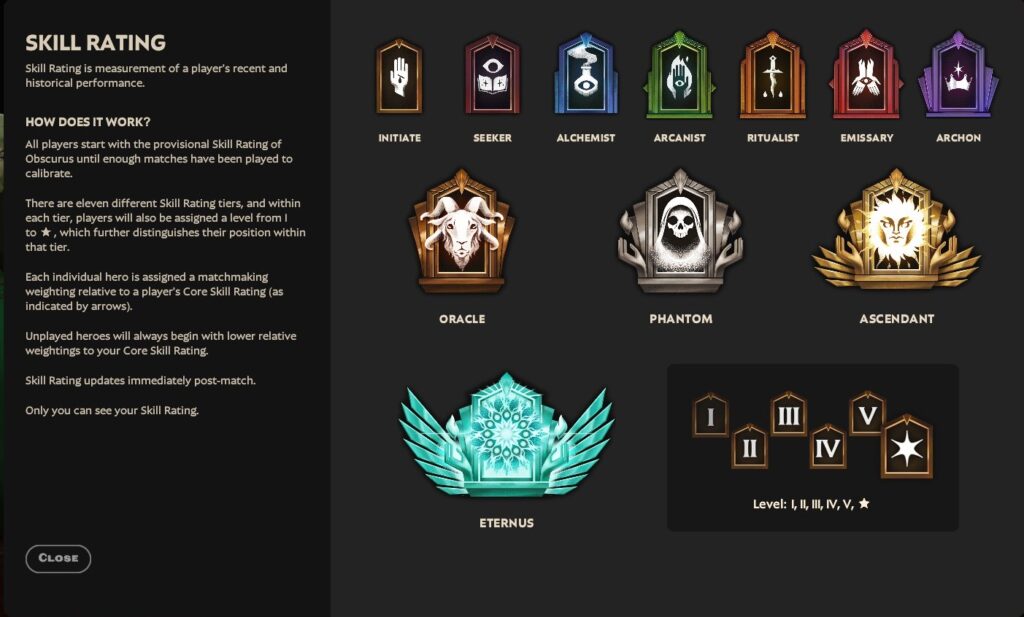
Deadlock's medal system has 11 distinct ranks, each split into 6 sub-ranks (I through VI, with VI being the highest within that tier). Starting from the bottom: Initiate, Seeker, Alchemist, Arcanist, Ritualist, Emissary, Archon, Oracle, Phantom, Ascendant, and Eternus at the top. There's also Obscurus at rank 0, which is the unranked placeholder you get if you don't meet the weekly requirement. Each sub-rank is a small step forward, but the gaps between the main medals are significant.
So where does the average player sit? According to distribution data, Emissary 3 or 4 used to represent roughly the top 15% of players - meaning the "average" was actually lower than many people assumed. After a rank recalibration patch, players who were at Emissary 3 or 4 got shifted upward into Phantom or Ascendant, but their percentile position stayed the same. In other words, your badge might look higher now, but you're competing against the same relative skill pool. More recent player reports suggest the average rank in 2026 hovers around Emissary to Archon, though that's shifting as the player base matures and new players enter during open beta.
- 11 medals, 6 sub-ranks each: The full ladder runs from Initiate (lowest) to Eternus (highest), with Obscurus as the unranked fallback.
- Emissary 3/4 was top 15%: Before the rank recalibration, hitting Emissary 3 or 4 put you in the 85th percentile - not "average" by any means.
- Rank shift inflated badges: After the recalibration patch, players at Emissary moved up to Phantom/Ascendant without changing their actual skill percentile. Your badge may look higher, but your relative standing is the same.
- Current average: Most players in 2026 report settling between Emissary and Archon, though this will change as the game moves toward open beta and the player pool expands.
How to Actually Climb in a Weekly System
Because Deadlock doesn't give you instant feedback after each match, you can't just "grind out" a rank in a single evening. Your goal each week is to play consistently well across at least 7 games - and preferably more, since the algorithm weighs your overall performance window, not just your win rate. If you go 5-2 one week and 2-5 the next, your rank will bounce accordingly. The system rewards sustained performance, not a lucky streak.
This also means you should treat each week like a mini-season. Focus on three heroes you can play at a high level - the game lets you select three in standard mode, so practice those specifically before queuing ranked. Coordinate with teammates even in solo queue; Deadlock's map and objective timings reward communication more than raw mechanics. And don't panic if you tank a few games in one session - the weekly reset gives you a clean slate every Monday. Use the early days of the week to experiment and the later days to lock in your best heroes once you've got a feel for the patch.
- Play more than 7 games: The minimum gets you a rank, but playing 10-15 games gives the algorithm a larger sample size and reduces the impact of one bad match.
- Stick to a 3-hero pool: Practice three heroes in standard mode before taking them into ranked. Hero mastery matters more in Deadlock than in many other MOBAs due to the movement and aim mechanics.
- Communicate every game: Even basic callouts on enemy positions and objective timings can swing close matches. Deadlock's map is large and rotations are punishing if you're silent.
- Use the weekly reset strategically: Early in the week, test new patches or heroes. Late in the week, lock in your best picks to close out a strong performance window before Monday's recalculation.
How Individual Match Performance Impacts Your Rank Change
Your weekly rank is not simply a win-loss tally. Deadlock's internal MMR system evaluates per-hero performance across your top seven matches each week. Factors such as objective damage, souls per minute, and kill-death-assist ratios relative to your hero's average on that map are weighted. For example, a 14-2-8 game on Abrams with 45k objective damage will raise your MMR more than a 5-5-10 win on the same hero, even if both are victories. The system compares your stats against the global average for that hero at your current rank bracket.
This means a loss can still improve your rank if you outperform expectations. If you lose a close match but post stats in the top 15% of your hero's performance tier, your MMR may drop less - or even stay flat. Conversely, a win where you finish with bottom-decile stats (e.g., 2-8-3 with low creep score) can yield a negligible or negative MMR adjustment. Valve has confirmed this via the Patch 1.1 patch notes (October 2024) which explicitly states "personal performance metrics now influence weekly recalculation more heavily in the lower and middle ranks."
- Souls per minute (SPM): Maintaining 950+ SPM by the 20-minute mark is the baseline for a positive performance adjustment in Phantom rank and above.
- Objective damage threshold: Dealing at least 30% of your total damage to objectives (Guardians, Walkers, Patron) is required to avoid a negative performance penalty on tank/initiator heroes like Abrams or Bebop.
- Hero-specific benchmarks: Valve publishes internal hero performance curves; for Vindicta, a 2.0 KDA is average, while 3.5+ counts as a "carry" performance that boosts MMR by approximately +15 hidden points per match.
- Death cap rule: In any single match, more than 12 deaths automatically caps your performance score at "neutral," regardless of kills or assists, to discourage feeding.
Understanding the Role of Party Play and Solo Queue in Ranked
Deadlock's ranked mode allows parties of up to three players, but the matchmaker applies a party MMR penalty to balance coordination advantages. If you queue with a friend whose rank is more than two full tiers above or below yours (e.g., an Archon queuing with a Bronze), the system treats the party as if both players are one tier lower for matchmaking purposes. This means you will face opponents roughly 1.5 tiers above your average, making it harder to win and thus harder to climb. Solo queuers receive a small solo queue bonus (estimated +5 MMR per match) to offset the lack of voice coordination.
Party size also affects weekly recalculation. If you play your top seven matches in a full three-stack, the system weights your individual performance less heavily - only 40% of the MMR change comes from personal stats, versus 70% for solo players. This is designed to prevent boosting. For example, a three-stack that wins all seven matches will see roughly 20% less rank gain than a solo player with identical stats who wins the same number of games. The difference becomes more pronounced at higher ranks: in Eternal tier, solo queue performance accounts for 85% of the weekly adjustment.
- Party MMR penalty: Queuing with a player two or more tiers apart reduces your effective team MMR by 1 tier, making matches harder to win.
- Solo queue bonus: Solo players receive a hidden +5 MMR per match played, applied after the match result is calculated.
- Performance weight shift: In a three-stack, personal stats contribute only 40% of your MMR change; in a duo it is 55%; solo it is 70% (per Valve's Ranked FAQ v1.2).
- Cross-tier restrictions: Parties with a rank gap exceeding 4 tiers (e.g., Initiate and Oracle) are prohibited from queuing ranked together to prevent smurfing.
Frequently Asked Questions
How often do ranks update in Deadlock?
Once per week, on Tuesday mornings (Pacific Time). Your rank does not change after every match; instead, the system aggregates your MMR movements from the entire week and then assigns a new medal during the weekly recalibration. This prevents daily volatility and gives you a full week to climb before the next snapshot.
Can I lose my rank if I don't play for a while?
Yes, after 14 days of inactivity your rank will decay. The decay rate is approximately one full tier per two weeks of missed play, though your hidden MMR is preserved. Once you queue again, you'll need to win matches to regain your previous medal - this is designed to keep the leaderboard accurate for active players.
Does playing support heroes lower my MMR gain?
No. Deadlock's performance metric evaluates your impact relative to your hero's role, not raw kills. A Bebop with high hook accuracy and objective damage gains as much MMR as an equally impactful Haze. The system uses role-adjusted stats (e.g., healing per minute for supports, tower damage for carries) so that every playstyle is rewarded fairly.
Conclusion
Climbing in Deadlock's weekly ranked system comes down to three concrete actions: maintain a 50%+ win rate to offset the weekly MMR decay, queue solo or duo to maximize your individual performance weight (70% solo / 55% duo), and focus on role-adjusted stats rather than chasing kills - the system rewards efficiency, not ego. Ignore daily rank fluctuations; only the Tuesday reset matters. Play consistently, play your role well, and the medal will follow.